
Key Highlights
- Modernization is now a requirement, not a competitive differentiator for retirement recordkeepers facing rising technology expectations, regulatory complexity, cybersecurity risks, and pricing pressure.
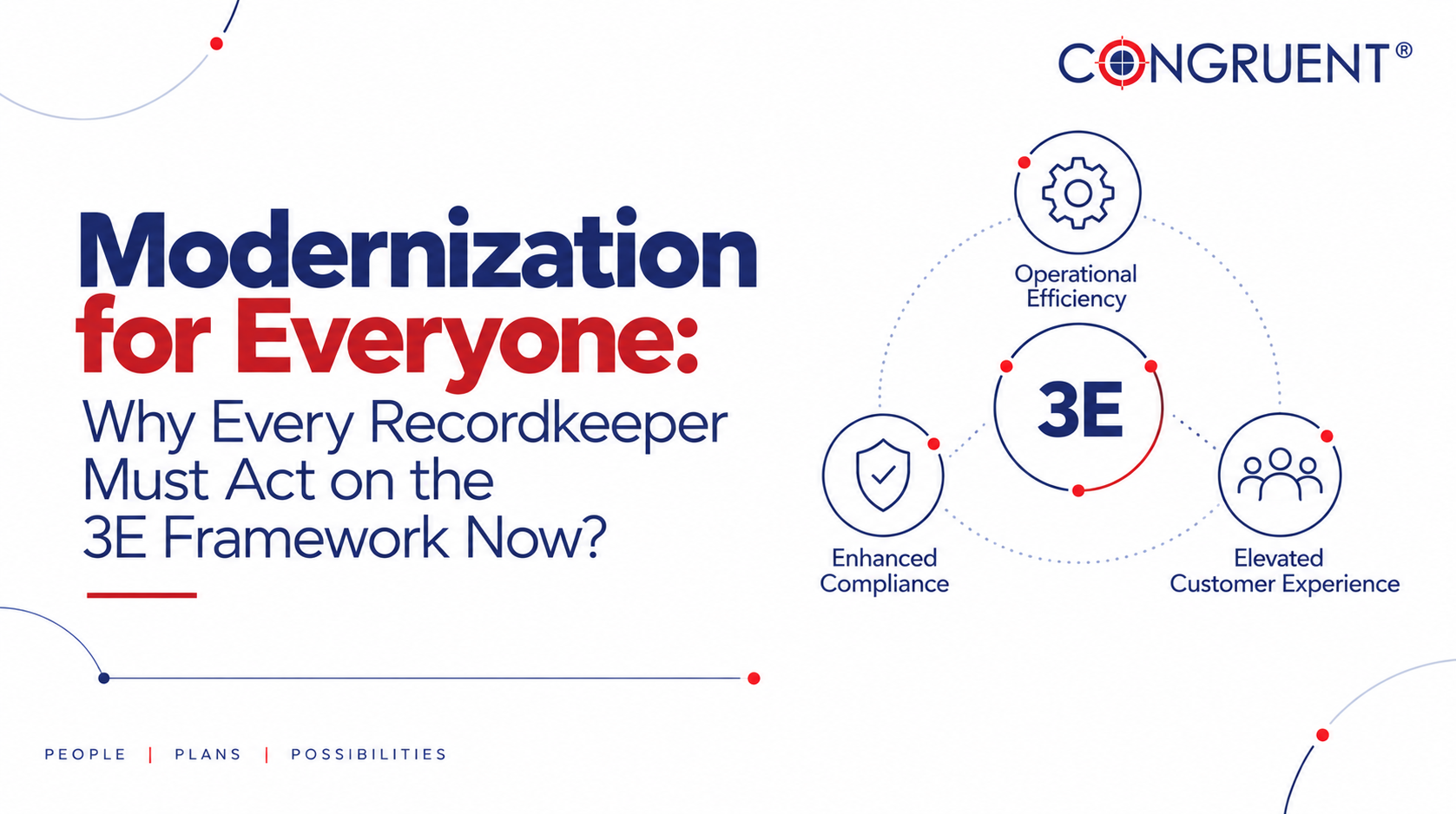
- The 3E framework—Efficiency, Experience, and Effectiveness—provides a universal modernization framework for recordkeepers regardless of their size, business model, or current position on the modernization curve.
- AI is becoming the engine behind modernization, automating rules-heavy operational tasks, improving user experiences, reducing errors, and enabling faster, more consistent decision-making.
- API-first, modular architectures and open integrations are critical to building scalable, adaptable recordkeeping platforms that can evolve continuously.
- Modernization can deliver measurable business results: the example in the article reduced onboarding time from three months to 1–2 weeks, improved cost efficiency by more than 10×, and reduced error rates by 5–10 points.
Over the past few months, we have discussed the Retirement Tech Modernization Quadrant to explore the four distinct archetypes shaping the retirement recordkeeping landscape. We have discussed how each recordkeeper sits at a different point on the modernization curve. From the Legacy Laggards to Modernizing Movers, At-Risk Complacent, and Innovation Leaders, each responds differently to the pressures of technology, regulation, cost, and customer expectations.
No matter your role or position, every recordkeeper needs to modernize. Modernization is no longer a way to stand out. It is the basic requirement to stay competitive in a world shaped by digital demands, complex regulations, growing cyber threats, and constant pricing pressure.
This article discusses the importance of modernization for recordkeepers and offers clear direction for the future.
The 3Es: The universal outcomes every recordkeeper must deliver
No matter the quadrant, business model, or company size, all recordkeepers are working toward the same goals.
At Congruent, we call these the 3Es:
- Efficiency: Automating everyday operations such as payroll scrubbing, data normalization, and compliance checks enables operations to run faster and more cost-effectively.
- Experience: Clean, intuitive, predictable interactions for every stakeholder, including participants, sponsors, advisors, and internal teams.
- Effectiveness: Measurable improvements in participant outcomes and sponsor value through fewer errors, faster decisions, and better plan design.
These are the operational yardsticks for recordkeepers that will decide who thrives and who takes the lead in the next decade.
1. Efficiency: Automating the messy middle
Recordkeepers must run leaner operations without compromising quality.
Efficiency is about:
- Reducing manual work
- Eliminating redundant checkpoints
- Streamlining integrations
- Shortening processing cycles
- Controlling cost-to-serve
With fees continuing to fall and price competition intensifying, efficiency is no longer optional. It’s survival.
2. Experience: Making every interaction relevant and human
Experience is what plan sponsors, advisors, and participants notice first. Recordkeeping may be complex on the inside, but externally, every interaction must feel simple, reliable, and frictionless.
A great experience means:
- Digital journeys that are consistent and intuitive
- Fewer back-and-forth emails with sponsors
- Clear, contextual guidance for participants
- Interfaces that reduce errors and confusion
- Predictability in how tasks flow, how long they take, and what happens next
With a tech-savvy generation of plan participants, recordkeepers can no longer afford clunky workflows, confusing portals, or unpredictable turnaround times. A clean experience directly impacts plan sponsor trust in your recordkeeping services. When sponsors feel confident, participants stay engaged, and advisors find value, experience becomes a competitive differentiator.
3. Effectiveness: Driving better outcomes for sponsors and participants
Effectiveness is where modernization proves its value. Recordkeepers have always aimed to deliver accurate processing, compliance, and timely service. However, effectiveness today is not just about getting the operations right. It’s about delivering quality outcomes.
Effectiveness shows up in:
- Fewer errors and rework
- Faster decision-making during events like enrollment, eligibility, distributions, or loans
- Accurate and personalized participant guidance
- Stronger plan design recommendations backed by data
- Better compliance posture with auditable workflows
Why the 3Es matter?
Even if a recordkeeper believes they are “fine for now,” the rapidly evolving 401(k) retirement plan environment makes inaction the biggest risk, because:
- Clients are demanding better experiences: Sponsors expect recordkeepers to be strategic partners by offering cutting-edge technology, excellent customer service, and compliance support.
- Costs are going down, expectations are going up: Price compression is real. Firms must operate more efficiently to maintain margins.
- Errors are unforgiving: The industry’s tolerance for delayed processing, compliance misses, and manual errors is dropping fast.
- Regulation is tightening: From SECURE 2.0 to new cyber governance expectations and long-term part-time eligibility rules, the complexity keeps growing.
- AI is raising the standard: Tasks that used to take weeks now take just days. Processes that once required entire teams can now be safely automated at scale.
These changes make 3Es existential necessities for recordkeepers.
AI: The engine behind the 3Es
AI is no longer a futuristic investment. Embedded AI that works behind the scenes to coordinate tasks and deliver results is the operating backbone for modern recordkeeping.
Here is how AI is redefining all three Es:
- AI drives efficiency
AI automates the high-volume, rules-heavy tasks that consume most operational hours:
- Extracting rules from adoption agreements
- Scrubbing payroll files
- Normalizing participant data
- Identifying compliance exceptions
- Detecting anomalies in contributions and eligibility
Manual processes that once required multiple analysts and long review cycles can now be completed accurately in minutes.
- AI enhances experience
AI-based systems can guide users through processes with clarity and predictability:
- Participants get intelligent and contextual responses
- Sponsors get quicker clarification, which reduces support interactions
- Internal teams get real-time decision support and actionable insights
AI simplifies complexity, improving the user experience directly.
- AI improves effectiveness
Effectiveness is about outcomes, and AI strengthens outcomes through:
- Higher first-pass accuracy
- Fewer exceptions
- Faster processing for time-sensitive activities
- More consistent rule interpretation
- Better insights for plan design and participant engagement
AI doesn’t replace your expertise but makes it better.
Modernization comes alive with Congruent Solutions
For more than two decades, Congruent Solutions has helped retirement recordkeepers modernize not just their technology, but the way their operations think, act, and evolve. We believe that modernizing recordkeeping should deliver a better experience, greater efficiency, and improved effectiveness. We call these the 3Es.
Over the years, we’ve invested deeply in workflow automation, AI-powered data intelligence, cloud-native architecture, and API-driven interoperability. Today, our teams bring a mature understanding of where AI creates real operational value, whether in cleaning messy data, predicting exceptions, improving participant journeys, or enhancing compliance reliability.
Modernization measured: The impact in numbers
A large enterprise-level recordkeeper partnered with Congruent Solutions to modernize its onboarding process, which was slow, manual, and error-prone.
The problem:
Being dependent on human interpretation of 50–70+ page plan documents, the extraction process took 3–5 days. Sponsors were required to follow rigid data-mapping templates. Still, error rates hovered around 20–25%, and overall onboarding stretched up to 3 months.
The solution:
Using Congruent’s API-enabled CORE Platform, CORE Mapper, and AI-powered document intelligence, the recordkeeper transformed onboarding end-to-end. AI now extracts and interprets plan rules in just 30 minutes with up to 90% confidence, while CORE Mapper accepts data in any format and auto-normalizes it for downstream systems.
The results:
3Es: Efficiency, Experience, and Effectiveness were delivered to the recordkeeper by the CORE platform and our experts.
Onboarding time reduced from 3 months to 1–2 weeks, more than 10× cost efficiency, a 5–10 point drop in errors, fewer handoffs, sharply reduced clarifications, and dramatically improved sponsor and participant experience—all delivering Congruent’s 3Es: Efficiency, Experience, and Effectiveness.
Our solution helped the recordkeeper reduce onboarding time from three months to just one or two weeks. Cost efficiency improved by more than 10 times, and error rates dropped by 5–10 points. By decreasing handoffs and the need for clarification, we dramatically improved the sponsor and participant experience.
How recordkeepers should approach modernization
Regardless of quadrant or capability, here are strategic lessons every recordkeeper should carry into their modernization roadmap:
1. Treat modernization as a continuous journey: An agile and iterative approach to modernization makes it an ongoing process, not a one-time project.
2. Modernize the middleware first: Payroll, data flows, configuration, and compliance, as these areas unlock immediate ROI.
3. Adopt modular and API-first architectures: The future belongs to platforms that integrate cleanly with other systems and allow for easy scalability.
4. Embrace integrations and open ecosystems: Integration is the new currency, and your ability to connect determines your ability to compete.
5. Invest in talent, governance, and AI maturity: Success is about deploying AI responsibly, securely, and transparently. Use AI where it can have the greatest impact, such as processes that involve many documents, strict rules, and high volume.
6. Measure impact: Track cycle times, first-pass accuracy, sponsor satisfaction, and participant engagement. These will prove modernization ROI more clearly than any feature list.
Step into the future of retirement recordkeeping
Modernization may look different for every recordkeeper, but they start moving toward that future now by anchoring their strategy around the 3Es. Innovation Leaders aren’t waiting for the future. They’re shaping it.
Whether you’re catching up, midway through, or at risk of complacency, Congruent Solutions is ready to help you accelerate that journey with the tools, expertise, and partnership model to make modernization smarter, faster, and far less disruptive.
If you haven’t turned modernization into clear metrics for experience, efficiency, and effectiveness, that’s the first step. If you’ve already done that, it’s time to pick up the pace and focus on deploying what truly matters.
Ready to map your modernization to the 3Es? Let’s talk.
Frequently asked questions
Key questions on the 3E Framework — Efficiency, Experience, and Effectiveness — and how recordkeepers can use it to guide modernization, deploy AI, and measure real operational impact.
The 3E Framework defines the three universal outcomes every recordkeeper must deliver regardless of size or modernization stage: Efficiency (automating operations to run faster and more cost-effectively), Experience (clean, intuitive, predictable interactions for participants, sponsors, advisors, and internal teams), and Effectiveness (measurable improvements in participant outcomes and sponsor value through fewer errors and better plan design). These are the operational yardsticks that will determine who leads the next decade of retirement recordkeeping.
Modernization has shifted from a way to stand out to the minimum standard to remain competitive. Digital demands, complex SECURE 2.0 regulations, growing cybersecurity threats, and constant pricing pressure have collectively made inaction the highest-risk strategy. Recordkeepers that delay face compressing margins, rising error rates, client attrition, and competitive displacement by AI-native entrants — all simultaneously.
Efficiency means running leaner operations without compromising quality — reducing manual work, eliminating redundant checkpoints, streamlining integrations, shortening processing cycles, and controlling cost-to-serve. With fees continuing to fall and price competition intensifying, efficiency is no longer a goal to strive toward. It is a survival requirement for recordkeepers operating in today’s margin-compressed environment.
Experience refers to the quality of every interaction across all stakeholders. A great experience means intuitive digital journeys, fewer back-and-forth emails with sponsors, clear contextual guidance for participants, and predictable turnaround times. When sponsors feel confident in their recordkeeper’s reliability, participants stay engaged and advisors find value — making experience a direct driver of plan sponsor trust and long-term retention.
Effectiveness is where modernization proves its value. It goes beyond accurate processing to delivering measurable quality outcomes: fewer errors and less rework, faster decision-making during enrollment, eligibility, distributions, or loan events, accurate and personalized participant guidance, stronger plan design recommendations backed by data, and a better compliance posture with fully auditable workflows.
Clients expect recordkeepers to be strategic partners with cutting-edge technology. Fee compression is real and ongoing. Industry tolerance for processing delays, compliance misses, and manual errors is dropping fast. SECURE 2.0, new cyber governance expectations, and LTPT eligibility rules keep adding complexity. And AI is raising the standard — tasks that once took weeks now take days. Inaction means falling further behind on all of these dimensions simultaneously.
AI drives Efficiency by automating payroll scrubbing, data normalization, compliance exception detection, and plan rule extraction — completing in minutes what once required multiple analysts. AI enhances Experience by guiding participants with contextual responses, giving sponsors faster clarification, and providing internal teams with real-time decision support. AI improves Effectiveness through higher first-pass accuracy, fewer exceptions, faster processing of time-sensitive events, and better insights for plan design and participant engagement.
A large enterprise recordkeeper was relying on manual interpretation of 50–70+ page plan documents, with 3–5 day extraction cycles, 20–25% error rates, and 3-month onboarding timelines. Using Congruent’s CORE Platform, CORE Mapper, and AI-powered document intelligence, plan rule extraction dropped to 30 minutes at up to 90% confidence. Onboarding time fell from 3 months to 1–2 weeks, cost efficiency improved by more than 10x, and error rates dropped by 5–10 points — with fewer handoffs and sharply reduced sponsor clarification burden.
Six principles guide effective modernization: (1) Treat it as a continuous journey, not a one-time project; (2) Modernize middleware first — payroll, data flows, and compliance logic — for immediate ROI; (3) Adopt modular, API-first architecture for clean integration and easy scalability; (4) Embrace open ecosystems, since integration capability determines competitive capability; (5) Invest in AI governance and maturity, deploying AI where it has greatest impact; and (6) Measure impact through cycle times, first-pass accuracy, sponsor satisfaction, and participant engagement.
The first step is anchoring strategy around the 3Es — translating modernization into clear, measurable metrics for Efficiency, Experience, and Effectiveness. From there, modernizing the middleware layer — payroll integrations, data normalization, compliance logic, and configuration workflows — typically delivers the fastest and most measurable return on investment before any front-end or participant-facing changes are made.



