
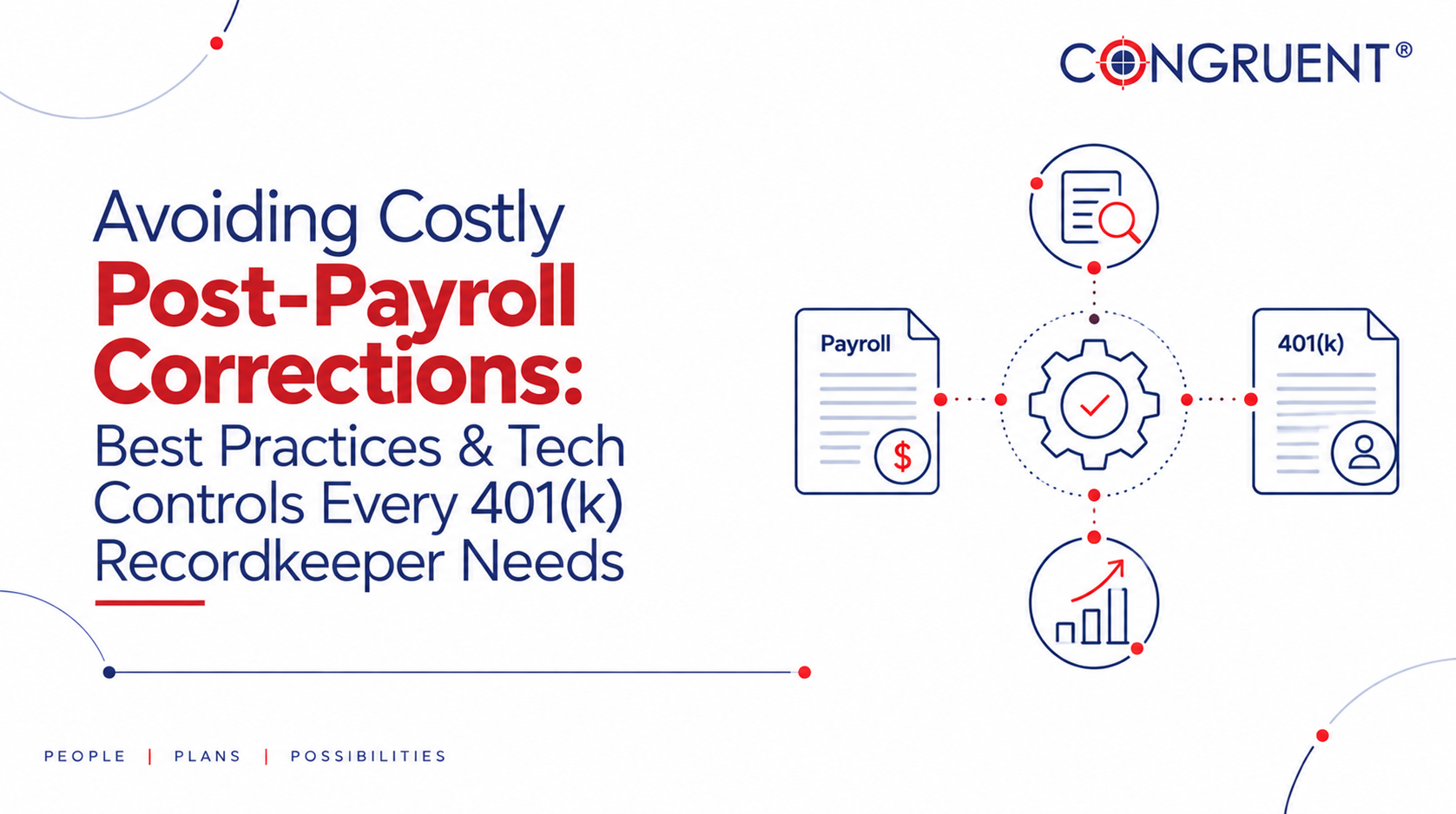
Post-payroll corrections are among the most expensive, time-consuming, and reputationally damaging operational failures a 401(k) recordkeeper can face. Issues such as recharacterizations, lost earnings calculations, make-up contributions, and IRS correction filings consume resources that could otherwise support growth and improve outcomes for participants. Mistakes such as missed deferrals, incorrect employer matches, or late payments can lead to compliance risks, participant dissatisfaction, and increased regulatory scrutiny.
With SECURE 2.0 now in full effect and SECURE 2.0 plan amendments due by December 31, 2026, the compliance stakes are higher. Expectations for accuracy, timeliness, and auditability are increasing, so recordkeepers can no longer rely on reactive fixes.
This article explains the best practices and technology controls for recordkeeping. We will focus on proactively improving processes, strengthening controls, and using smarter technology.
Why do post-payroll corrections happen in 401(k) retirement plans?
Post-payroll corrections in 401(k) plans rarely stem from a single issue. Instead, they are typically the result of fragmented payroll ecosystems, manual dependencies, and inconsistent or incomplete data flowing between plan sponsors and recordkeepers. As payroll environments become more complex, with multiple providers and evolving regulations, controlling risks requires robust preventive measures.
Most post-payroll errors trace back to a small number of recurring root causes:
- Inaccurate or incomplete payroll data, such as missing fields, incorrect compensation figures, or outdated employee information, are the primary drivers of downstream plan errors.
- Manual data entry and intervention increase the likelihood of keying errors, incorrect overrides, and changes made without proper audit trails or validation checks.
- Mismatch between payroll and recordkeeping systems, such as in contribution codes, file formats, or mapping logic, can result in misallocated contributions and distorted participant balances.
- Incorrect deferral calculations lead to under- or over-contributions, requiring corrective adjustments and potential employer funding.
- Eligibility and enrollment errors, even for part-time workers or newly enrolled participants, can cause missed or late contributions.
- Late or missed payroll submissions may delay contributions, causing compliance issues and corrective actions.
- Stale or inconsistent census data on compensation, employment status, or demographics may affect the accuracy of contributions and nondiscrimination testing outcomes.
- Errors in classifying catch-up contributions, particularly due to evolving Roth treatment requirements, are leading to increased reprocessing and corrections.
- Fragmented payroll systems and evolving regulations, such as SECURE 2.0, add complexity and increase the risk of errors when managing multiple payroll providers.
What are the risks of not fixing payroll errors proactively?
Failing to prevent or quickly correct payroll errors can lead to:
- Compliance failures, including violations of IRS and DOL regulations
- Costly corrections, such as QNECs (Qualified Non-Elective Contributions)
- Audit findings and penalties
- Participant complaints and potential litigation
- Operational inefficiencies and rework
In many cases, the cost of fixing an error far exceeds the cost of preventing it.
What best practices help reduce post-payroll corrections?
1. Standardize payroll data intake
Ensure clean, consistent data before it enters the recordkeeping system by:
- Implementing standardized data templates
- Enforcing validation rules at the point of upload
- Using automated mapping for different payroll providers
2. Shift from batch processing to real-time validation
Reduce downstream corrections with:
- Pre-processing validation checks
- Real-time error alerts for missing fields or out-of-range values
- Immediate feedback to plan sponsors
3. Automate eligibility and contribution logic
To handle long-term part-time employee eligibility under recent regulatory updates:
- Configure rules-based engines for eligibility tracking
- Automate contribution calculations based on plan provisions
- Continuously update logic for regulatory changes
4. Implement end-to-end reconciliation controls
Eliminate reconciliation gaps by:
- Automating reconciliation between payroll files and contribution postings
- Using exception-based workflows to flag mismatches
- Maintaining audit trails for all adjustments
5. Enable sponsor self-service with guardrails
Reduce back-and-forth communication and improve data accuracy at the source with:
- Guided self-service portals
- Embedded validation checks within sponsor workflows
- Real-time status tracking and error notifications
What technology controls should modern recordkeepers implement?
To minimize post-payroll corrections, recordkeepers need to go beyond process improvements and adopt advanced technology controls. Here is the technology upgrade you need:
1. Data validation engines
Modern platforms should include configurable validation engines that:
- Check data completeness and accuracy
- Validate against plan rules
- Flag anomalies using predefined thresholds
2. Workflow automation with exception handling
Automated workflows ensure consistency while focusing human effort where it’s needed most. The system must:
- Route exceptions to the right teams
- Track resolution timelines
- Maintain full audit logs
3. Integration with payroll providers
Seamless integrations reduce manual intervention and data discrepancies through:
- API-based data exchange
- Real-time synchronization
- Reduced dependency on file uploads
4. Audit-ready reporting and traceability
With increasing regulatory scrutiny, audit readiness is non-negotiable, so you must:
- Maintain detailed audit trails
- Generate compliance-ready reports
- Track every data change and correction
5. Predictive analytics and anomaly detection
Forward-looking recordkeepers are now leveraging AI-driven insights to prevent errors before they occur. AI-driven systems help:
- Identify patterns in historical corrections
- Predict high-risk payroll scenarios
- Proactively alert teams and sponsors
Switch to Congruent Solutions to reduce post-payroll corrections
Avoiding post-payroll corrections requires the right combination of technology, automation, and domain expertise. Congruent Solutions enables this shift through a combination of its Retirement Edge platform and the CORE ecosystem, both designed to modernize recordkeeping operations and eliminate the root causes of payroll errors.
With Retirement Edge, recordkeepers can:
- Standardize and validate payroll data upfront with configurable ingestion frameworks
- Automate eligibility, contributions, and reconciliation workflows using rules-driven engines
- Enable sponsor self-service with built-in validations and real-time feedback
- Ensure audit readiness through comprehensive tracking and reporting
- Use intelligent automation to identify and prevent errors before they occur
The CORE Platform introduces a prevention-first architecture across the payroll lifecycle:
- CORE Payroll delivers real-time contribution validation, automated match and non-elective calculations, and continuous monitoring of IRS limits. It prevents errors like excess contributions and source mismatches before posting.
- CORE Eligibility automates complex eligibility rules, including SECURE 2.0 provisions such as long-term part-time tracking and mandatory auto-enrollment, ensuring timely and accurate participant inclusion.
- CORE Mapper uses AI-driven data standardization and validation to handle inputs from thousands of payroll providers, ensuring clean data flows into recordkeeping systems.
- CORE PlanSuite centralizes and automates plan configuration and onboarding, creating a single source of truth for plan rules, provisions, and limits. It eliminates a major upstream cause of payroll and contribution errors by providing accurate, up-to-date, and consistent data across systems.
- Native integrations, including partnerships with providers like Finch, enable bi-directional payroll and HRIS synchronization, eliminating reconciliation gaps and manual data handoffs.
In addition, Congruent’s managed services and deep retirement domain expertise help recordkeepers streamline operations, reduce compliance risk, and scale efficiently.
Contact our team today to move beyond reactive corrections and build a future-ready recordkeeping operation.


