
For 401(k) recordkeepers, 2026 is not business as usual. The mandatory Roth catch-up provision under SECURE 2.0 took effect on January 1, 2026, requiring catch-up contributions to be treated as Roth for participants with prior-year FICA wages above the indexed threshold, which is approximately $145,000–$150,000.
This seemingly straightforward rule exposes a long-standing vulnerability in the retirement ecosystem, where the FICA wage data gap exists in payroll-to-recordkeeper communications.
Historically, recordkeepers have not had consistent, real-time access to FICA wage data, but with the implementation of SECURE 2.0, the gap is no longer operationally manageable. It directly impacts eligibility determination, contribution treatment, and compliance. As a result, recordkeepers must now rely on enhanced payroll integrations, such as high-earner indicators or automated Roth designation logic, to ensure accurate and timely processing.
What is the FICA data gap in 401(k) plan administration?
The FICA data gap refers to the disconnect between payroll-calculated wages (subject to FICA taxes) and the data transmitted to recordkeeping systems for processing retirement plans.
This gap typically arises because:
- Payroll systems calculate FICA wages, Social Security limits, and Medicare taxes in real time.
- Recordkeepers receive delayed, incomplete, or transformed data via batch files.
- Key fields such as compensation definitions, pre-tax vs. Roth contributions, and wage caps may not align perfectly.
As a result, recordkeepers are left reconciling data that is already out of sync with payroll reality.
Why does the FICA data gap matter for recordkeepers?
FICA data gap matters for recordkeepers, impacting compliance, operations, and client trust in the following ways:
1. Contribution inaccuracies and compliance risk
Misaligned FICA wages can lead to:
- Incorrect employee/employer contributions
- Failure to respect IRS limits (402(g), 415(c), Social Security wage base)
- Increased risk of operational errors requiring correction under EPCRS
2. Delayed reconciliation and increased manual effort
Operations teams often spend cycles:
- Validating payroll files
- Investigating discrepancies
- Coordinating with plan sponsors and payroll providers
3. Participant experience issues
Participants may see:
- Incorrect contribution postings
- Delayed updates to balances
- Confusion around tax treatment
In a market where participants expect real-time information, these gaps are no longer acceptable.
Why are traditional payroll integrations failing in 2026?
File-based integrations are inherently reactive, as most recordkeepers still rely on:
- SFTP file transfers
- Batch processing cycles
- Periodic census updates
These approaches:
- Introduce latency, taking from hours to days
- Increase dependency on manual intervention
- Lacks real-time validation
- Fragmented payroll ecosystem
With multiple payroll providers, data comes in:
- Different data schemas
- Custom file formats
- Varying update frequencies
Standardization becomes difficult, and the FICA gap widens.
Increasing regulatory complexity leads to frequent updates in:
- Wage thresholds
- Catch-up contribution rules (including SECURE 2.0 provisions)
- Roth vs. Pre-tax treatment
These updates require systems that can adapt as needed, rather than relying on fixed file mappings.
What does API-first payroll integration mean for recordkeepers?
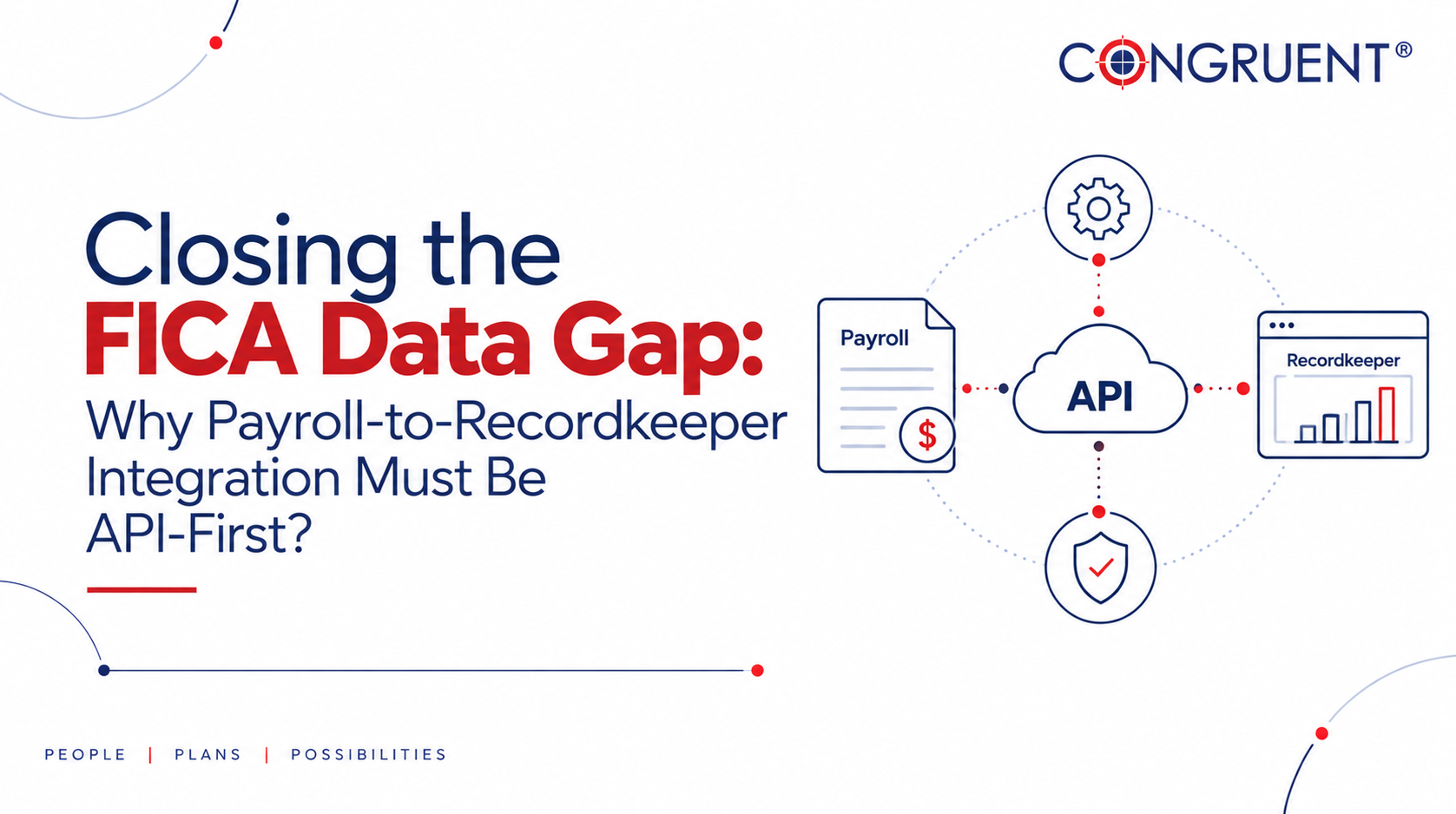
An API-first approach replaces batch file exchanges with real-time, event-driven data synchronization between payroll systems and recordkeeping platforms. It includes:
- Real-time data flow: Contributions, wages, and adjustments are transmitted instantly.
- Field-level validation: Data is validated at the source before transmission.
- Standardized data models: APIs enforce consistent structures across providers.
- Bi-directional communication: Recordkeepers can send acknowledgments, errors, or updates back to payroll systems.
How does API-first integration close the FICA data gap?
1. Real-time alignment of payroll and recordkeeping data
APIs ensure that:
- FICA wages, compensation, and contributions are captured and transmitted simultaneously.
- Recordkeepers operate on the same dataset as payroll, eliminating timing mismatches.
2. Improved accuracy through validation at source
Instead of fixing errors downstream:
- APIs validate contribution limits, eligibility, and compensation definitions upfront.
- Errors are flagged immediately to reduce rework.
3. Continuous reconciliation instead of periodic fixes
With APIs:
- Reconciliation becomes ongoing and automated.
- Adjustments such as corrections or reversals are processed instantly.
4. Enhanced auditability and compliance
APIs support audits, regulatory reviews, and internal controls:
- Detailed audit trails.
- Timestamped transactions.
- Clear data lineage.
How does Congruent Solutions help recordkeepers close the FICA data gap?
Congruent Solutions enables recordkeepers to transition from fragmented and file-based integrations to modern, API-first ecosystems. With platforms like Retirement Edge, recordkeepers can:
- Integrate seamlessly with multiple payroll providers through standardized APIs.
- Enable real-time data exchange, eliminating delays and reconciliation gaps.
- Automate validation, compliance checks, and contribution processing at scale.
- Gain end-to-end visibility into payroll-to-recordkeeping data flows.
- Support configurable data models that align with evolving regulatory requirements.
As the industry moves toward real-time processing and stricter compliance expectations, closing the FICA data gap is no longer optional. Beyond the recordkeeping technology platform, Congruent Solutions offers integration services, data transformation expertise, and domain-driven implementation support, ensuring recordkeepers can modernize without disrupting ongoing operations.
Partner with Congruent Solutions to turn integration from a pain point into a competitive advantage with a customized API-first strategy.



