
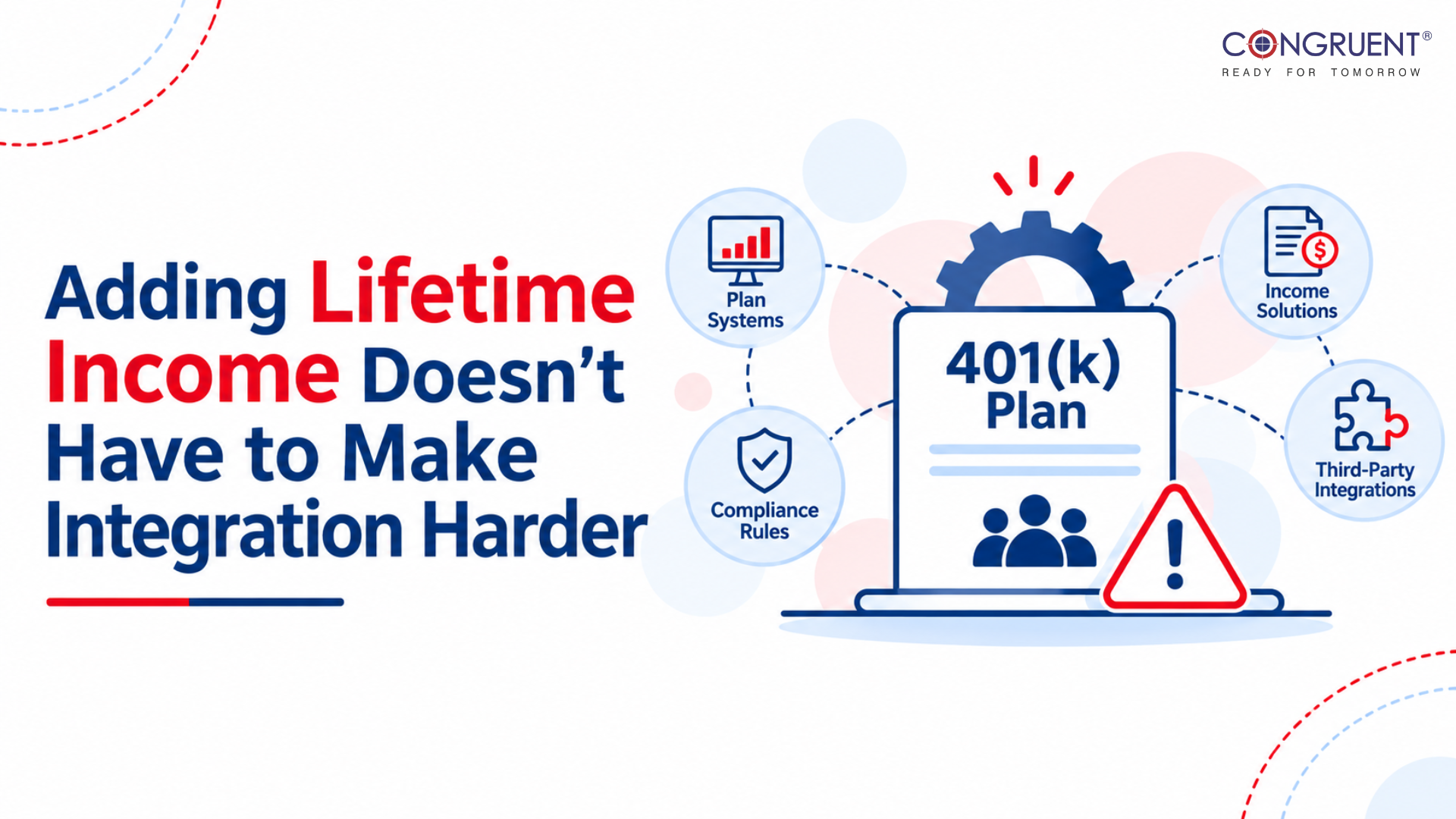
A plan sponsor asks their recordkeeper a simple question: “Can we add lifetime income next year?” The answer comes back fast: yes. SECURE 2.0 opened the door, and participants want more than a savings balance: a paycheck for life. Then the request reaches the operations team, and the real work begins.
What looked like a product decision turns out to be an integration project.
The product isn’t the problem. The plumbing is.
Your platform was built to accumulate, not to pay out
For decades, 401(k) recordkeeping has done one job well: take contributions in, invest them, track balances. Payroll feeds, fund trades and daily valuations are mature and standardized.
Lifetime income flips the model. Now the platform must manage annuity contracts, income activation, recurring payouts and an ongoing relationship with an insurer. None of that was in the original blueprint. Bolting it on means new data structures, transaction rules and reconciliation inside systems never designed for them. And that’s just inside your own walls.
There’s no Fund/SERV for annuities
Mutual funds and target-date funds ride on standardized rails like NSCC Fund/SERV. Connect once, and you can trade with almost anyone.
Annuities have no equivalent. Every insurance carrier brings its own data formats, contract identifiers, workflows and reporting. One carrier means one custom build. Five carriers means five. The integration effort doesn’t add up. It multiplies, and so does the maintenance. And once the connections are live, there’s the question of what flows through them.
New data your systems don’t speak
Lifetime income comes with a vocabulary your platform has never had to speak: guaranteed benefit values, contract IDs, income start dates, payout schedules and actuarial assumptions.
Most recordkeeping systems weren’t built to hold this data, let alone keep it in sync across insurers and custodians. When it’s fragmented, participant income projections drift, and trust drifts with them. Keeping it accurate gets even harder the moment anything changes.
Participants move. Guarantees have to move with them.
In retirement plans, change is constant: participants switch jobs, sponsors switch recordkeepers and plans convert. In an accumulation world, that’s a rollover. With a guaranteed income product, the contract and its guarantees must survive the move intact.
Without standardized portability workflows, this turns into manual coordination: verifying transfers, reconciling assets across systems and protecting guarantees mid-transition. At scale, operations teams feel it fast. And that strain lands hardest on older platforms.
Legacy architecture gets exposed
Siloed systems and overnight batch processing were tolerable when the job was tracking balances. Lifetime income demands real-time updates, automated reconciliation and connections to multiple outside providers.
Lifetime income doesn’t create these weaknesses. It makes them impossible to ignore. Then regulators add a layer of their own.
Compliance keeps raising the bar
Income projections need disclosures, annuity providers need fiduciary oversight and participants need education. Each of these requires new data feeds, audit trails and reporting across insurers, advisors and sponsors, and the rules are still evolving under SECURE 2.0.
An integration architecture that can’t flex will be rebuilt more than once.
The way forward: stop building one-offs
Which brings us back to that sponsor’s question. The recordkeepers who win on lifetime income won’t be the ones with the most custom integrations. They’ll be the ones who need the fewest.
That’s why we built CORE RetirementIncome Suite: an integration layer designed for the retirement income era. It connects recordkeepers, insurers, custodians and other partners so you can:
- Connect to multiple annuity carriers through a single integration
- Standardize data across insurers, recordkeeping systems and participant records
- Automate the annuity lifecycle, from product onboarding to income activation and payouts
- Give participants clear visibility into income balances and projections
- Streamline trading, reconciliation and reporting
Because it’s cloud-native and built on microservices, you can add income solutions without ripping out existing infrastructure.
The bottom line
401(k) plans are becoming retirement income plans. The question is no longer whether to offer lifetime income. It’s whether your platform can deliver it without drowning in integration work.
The next time a sponsor asks for lifetime income, your answer should be a confident yes, with no fine print.
Talk to our team to see how CORE RetirementIncome Suite can simplify your lifetime income integrations and future-proof your platform.


